
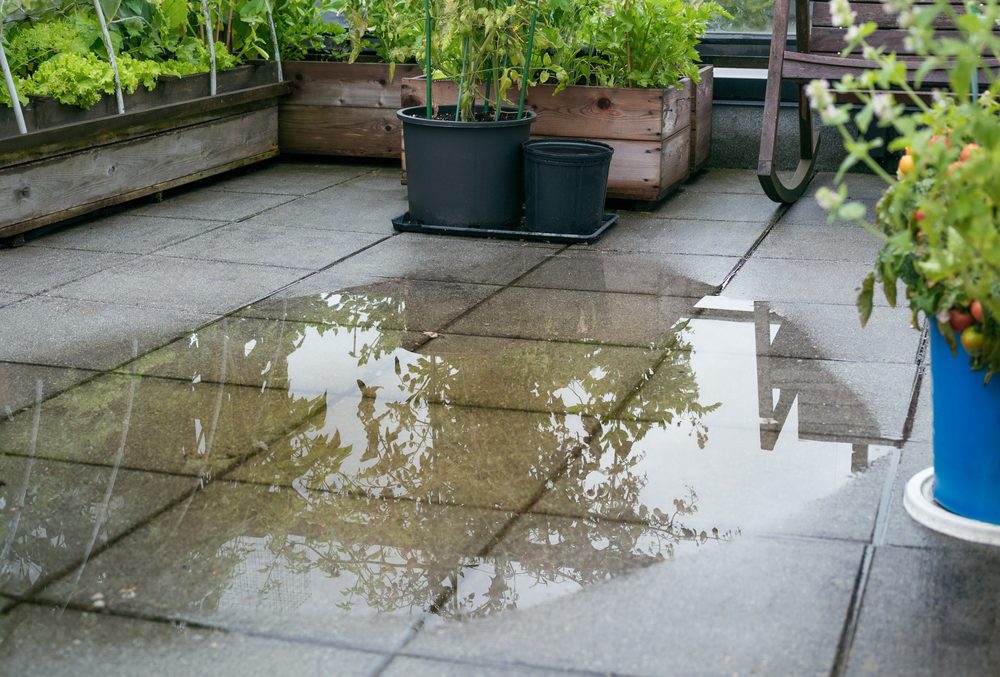

Where do you think Kansas City ranks as far as large cities that have the highest rainfall totals each summer? While we don’t get as much rain as other cities, Kansas City surprisingly ranked as number six, with over 5” of rain during our rainy season through the summer months. Now, picture all this rainfall, drenching your home’s exterior and your gutter system, working in overdrive to keep up with heavy precipitation.
Even the best gutter system can struggle to keep up with excessive rainfall, causing water to overflow off the sides. All this water will end up falling near your home’s foundation, on your concrete porch, patio, walkways, and driveways. While concrete is a durable building material, it’s prone to cracks and damage from excessive exposure to moisture.
Luckily, when concrete is damaged from drainage issues, there’s a way to repair it: polyjacking. Continue reading to learn how polyjacking for drainage improvement can help keep water away from your home’s concrete structures to avoid further damage.
Why Does Concrete Crack?
Some homeowners may start to question whether they chose the right contractor or concrete company when cracks appear in their driveways, patios, foundations, or other concrete structures. Despite a reputation for impressive strength and durability, concrete is susceptible to cracking. Below are just some of the many reasons why concrete cracks:
Concrete Cured Too Quickly
If concrete sets or dries too fast, it can compromise its structural integrity. The curing process requires moisture to evaporate at a controlled rate. If it dries too quickly—often due to high temperatures or strong winds—the concrete gets brittle and is more likely to crack.
Improper Placement/Not Enough Control Joints
Control joints are intentional weak spots that guide cracks in a controlled way. If these joints are missing or incorrectly placed, cracks can form randomly, often where they’re least wanted. This can result in unsightly cracks or weakened concrete.
Poured in Wrong Conditions
Concrete must be poured when the ground temperature is above freezing. Pouring on frozen soil can prevent proper bonding, and as it thaws, the shifting base can cause the slab to crack.
Dangers of Cracked or Unlevel Concrete
Level concrete makes it easy for loved ones and the general public to walk on an even, stable slab of concrete, whether it be unlevel concrete steps, a driveway, patio, or pool deck. However, uneven concrete presents challenges that can cause anyone to trip or fall. Young children, the elderly, or those with mobility challenges are more susceptible to serious injury from cracked and unlevel concrete, putting them at risk. Falls are just some of the many dangers of cracked or unlevel concrete:
- Slips and falls
- Pooling liquid that breaks down the concrete
- Liability lawsuits
- Foundation issues
- Basement leaks
- Pest infestations
- Structural issues
Unlevel or cracked concrete not only puts those you love at risk of serious injury, but also potentially damages your home and can be a liability lawsuit. Luckily, cracked and unlevel concrete can be repaired, and the best method is polyjacking, a concrete leveling technique that injects polyurethane foam directly under the unlevel concrete, permanently raising it and fortifying the soil.
How Polyjacking Improves Your Property’s Drainage Systems
Polyjacking can help improve your property’s drainage systems in a few ways. First, polyjacking raises unlevel or cracked concrete to level it again, allowing water to flow away from your home’s foundation and entryway, eliminating pooling water caused by unlevel concrete.
Secondly, lifting sunken or cracked concrete ensures the concrete slab has the proper slope to drain water away from your property, helping to keep your home drier and avoid pooling water. Lastly, because polyurethane foam lifts concrete, it eliminates cracks, removing pockets where water can seep inside. This prevents water from entering through tiny or large cracks that could seep into your home’s foundation and eventually create more cracks.
Polyjacking is a method used to raise sunken or uneven concrete by injecting expanding polyurethane foam beneath the slab. This foam fills gaps, stabilizes the soil, and lifts the concrete back to its original level. This process also has environmental benefits, as it eliminates the need to demolish and dispose of existing slabs, thereby reducing wasted materials. Once cured, the polyurethane foam is chemically inert, meaning it doesn’t leak harmful substances into the soil or air. Additionally, polyjacking requires no ongoing maintenance, unlike mudjacking, which often breaks down over time and may need to be redone.
Trust Pro Polyjacking, Kansas City’s Number One Concrete Leveling Company for Polyjacking for Drainage Improvement
Pro Polyjacking has been Kansas City’s number one concrete leveling company for over 30 years. We’re locally owned and operated, and proudly family-owned. We’ve served Kansas City homeowners and businesses for a variety of reasons, including commercial and residential needs big and small.
Getting started is simple. Cracked foundations, sunken driveways, and uneven sidewalks can be a serious eyesore—especially around businesses or homes. For lasting, professional results, trust Pro Polyjacking in Kansas City. Contact us today to learn more about how we can help with polyjacking for drainage improvement!